


Easel shopping can paralyze you with options. Here's how to cut through the noise: start with your constraints, then match features to how you actually work.

Easels Purchase Guide
You're halfway through a painting when the canvas wobbles. You steady it, make a stroke, and it wobbles again. By the end of the session, you've spent more energy fighting your equipment than creating art. Sound familiar?
A bad easel doesn't just annoy you—it actively makes your work worse. Unstable support means tentative brushstrokes. Wrong height means neck and back pain. Poor angle control means fighting gravity instead of working with it. The good news: unlike most art supplies that get used up, a quality easel lasts decades. The one you buy today might be the last one you ever need.
The Four Questions That Matter: Before you shop, answer these: (1) How big will your canvases be? This eliminates most options immediately. (2) Do you need to move it? Studio vs. field is a fundamental divide. (3) What medium do you work in? Watercolorists need tilt; pastel artists need forward lean. (4) How much space do you have? An H-frame in a closet-sized studio is a disaster.
Complete Guide Navigation
How to Choose (Without Overthinking It)
Start With Your Space (Be Honest)
Measure your studio—actually measure it. That gorgeous H-frame easel you're eyeing needs a 4×4 foot footprint minimum. If you're working in a spare bedroom or corner of a living room, that's not going to work. And remember: you need space to step back from your canvas. An easel that fits but leaves no room to view your work defeats the purpose.
Easel Types at a Glance
Space requirements and canvas capacity for each easel type.
| Easel Type | Floor Space Needed | Height Range | Max Canvas Size | Best For |
|---|---|---|---|---|
| Tabletop | 12"×8" to 24"×12" | 10"-20" | Up to 16"×20" | Small work, limited space, seated painting |
| A-Frame Studio | 24"×18" to 36"×24" | 48"-72" | Up to 36"×48" | Corner placement, medium canvases, smaller studios |
| H-Frame Studio | 36"×36" to 48"×48" | 48"-84" | Up to 60"×84" | Large canvases, professional work, maximum stability |
| Single Mast | 24"×24" to 30"×30" | 48"-78" | Up to 40"×60" | Compact studios, balance of stability and space |
| Field/French Box | Varies (folds for storage) | 36"-60" | Up to 24"×36" | Plein air, outdoor painting, travel |
Match Easel to Medium (This Actually Matters)
Different media have genuinely different requirements—this isn't marketing fluff.
Oil and Acrylic: You want vertical orientation and rock-solid stability. When you're loading a brush with paint and making confident strokes, the canvas shouldn't move. Adjustable height matters because you'll work on different parts of the canvas. A palette arm attachment keeps paint within reach.
Watercolor: Tilt is everything. You need to control water flow, which means adjusting from near-vertical (for washes running down) to near-horizontal (for wet-on-wet where you don't want pooling). An easel that only works vertically is useless for serious watercolor work.
Pastel and Charcoal: You need forward tilt—the opposite of what you'd expect. When the canvas tilts toward you, dust falls away from the surface instead of embedding in it. A tray below catches the fallout. Stability matters too; vibration smudges soft media.
Wood vs. Metal (And What the Wood Type Means)
Wood easels are traditional, beautiful, and—when well-made—last generations. But wood type matters:
Beech is the industry standard. Strong, reasonably heavy, takes finish well. Most quality European easels (Mabef, for instance) use Italian beech. This is the safe choice.
Oak and maple are harder and heavier—maximum stability for large work and vigorous painters. Professional-grade, professional price.
Pine and soft woods are budget options. Fine for light use and beginners, but they dent, wear, and wobble sooner.
Lyptus (used by Jack Richeson) is a sustainable alternative that performs like hardwood but grows much faster.
Metal easels serve different purposes:
Aluminum is essential for field work—light, rust-proof, folds compact. No wooden easel matches it for portability.
Steel appears in heavy-duty studio applications where maximum rigidity matters and weight isn't a concern.
Frequently Asked Questions
What's the difference between A-frame and H-frame studio easels?
A-frames have a triangular design (one leg in back)—they take less space and fit in corners but wobble more with large canvases. H-frames have a rectangular base—maximum stability for big, heavy work but they need serious floor space. If you're working over 30×40 inches regularly, lean toward H-frame.
Can I use a studio easel outdoors?
Technically yes, practically no. Studio easels are heavy, don't fold, and weren't designed for transport or uneven ground. If you want to paint outdoors, get a proper field easel—French box or aluminum tripod. Trying to wrestle a studio easel outside will make you miserable.
How much should I spend on my first easel?
For tabletop work or absolute beginners: $30-80 gets you something functional from US Art Supply. For a real studio easel you'll use for years: $200-400 for an A-frame (Jack Richeson Lyptus series or Mabef M02), $400-800 for a quality H-frame (Mabef M09, Jack Richeson Dulce). Don't go cheaper on studio easels—you'll replace them.
What easel features are essential for watercolor?
Tilt. Specifically, the ability to go from near-vertical to near-horizontal. Watercolor techniques depend on controlling water flow by adjusting angle. The Mabef M27 does this well. Any easel that only works vertically is useless for serious watercolor.
Do I need a different easel for large canvases?
Yes. Canvases over 30×40 inches need substantial support—H-frame easels (Mabef M09, Jack Richeson Dulce) or heavy-duty A-frames. Lightweight easels will wobble, tip, or fail to hold large canvases securely. The weight of the wet painting matters too.
How do I maintain my easel?
Wooden easels: keep away from extreme temperature/humidity swings. Oil wooden parts annually with lemon oil or similar conditioner. Check and tighten hardware regularly—screws loosen with use. Aluminum easels: clean with mild soap and water. Avoid abrasives that scratch protective coatings.
What if I don't have much space?
Single mast easels (Mabef M06) take less room than A-frames. Tabletop easels work on any flat surface. Some artists use wall-mounted systems. French box easels can be stored when not in use. But be honest about canvas size—if you want to paint large, you need space for a real studio easel.
💡 Pro Tip:
The One Rule That Matters: Buy the heaviest, most stable easel your space and budget allow. Every artist who's been at this for a while says the same thing: they wish they'd bought a better easel sooner. A wobbly easel makes you paint tentatively. A rock-solid easel lets you attack the canvas with confidence. Quality easels actually improve with age as the wood seasons and joints wear in.
Studio Easels (The Workhorses)
Studio easels are what most people picture when they think 'easel'—the substantial wooden frames that anchor a painting space. Three main types exist, each with real trade-offs.
A-Frame Easels: The triangular design (one leg in back, two in front) takes less floor space and fits nicely in corners. Trade-off: less stable than H-frames, especially with larger canvases. Good choices include the Jack Richeson Lyptus A-Frame (sustainable wood, solid build) and the Mabef M02 (Italian beech, classic design).
H-Frame Easels: The rectangular base provides maximum stability—essential for large canvases or if you paint aggressively. These are the professional standard for good reason. The Mabef M09 and Jack Richeson Dulce are industry workhorses. Trade-off: they need serious floor space (think 4×4 feet minimum).
Single Mast Easels: A vertical post design that splits the difference—more stable than A-frames, more compact than H-frames. The Mabef M06 and Jack Richeson Santa Fe work well for medium canvases in smaller studios.
Field and Travel Easels (Plein Air Reality)
Field easels exist because studio easels are impossible to transport. The trade-off is always stability vs. portability—you can't have maximum both.
French Box Easels: The classic plein air solution—a wooden box that holds your supplies, opens into an easel, and supports a canvas. Everything travels together. The Soltek Full French is the traditional choice; the Mabef M22 Half Box is more compact. Downsides: they're still fairly heavy (12-20 lbs loaded) and take practice to set up smoothly.
Tripod Field Easels: Lighter and simpler than French boxes. Three aluminum legs, a canvas holder, and not much else. The Mabef M27 and Jack Richeson Plein Air Tripod set up in seconds. Great for location scouting and quick studies. Less storage integration than French boxes—you'll need a separate bag for supplies.
Pochade Boxes: Ultra-compact systems that often work with a camera tripod you may already own. The pochade box itself holds palette and wet panel; the tripod provides support. Best for small work and serious weight-conscious painters.
⚠️ Important:
Field Easel Disasters (And How to Avoid Them): Wind is your enemy. A gust can send your easel, wet painting, and palette flying—ask anyone who's chased a canvas across a field. Hang a bag of rocks or sand from the center of your tripod. Choose models with spiked feet for grass and soft ground. Check the weather before you leave, and know when to quit—plein air in a thunderstorm isn't dedication, it's foolishness.
Tabletop Easels (Small But Not Trivial)
Tabletop easels aren't just for beginners—they're the right choice for small-scale work, limited spaces, and artists who paint seated.
When tabletop makes sense: Work under 16×20 inches. Detailed miniature painting. Limited studio space where a floor easel is impossible. Seated work (common for older artists or those with mobility issues). Travel where even a field easel is too bulky.
What to look for: Adjustable angle (essential for watercolor). Solid construction that won't tip when you load a canvas. The Mabef M34 is basically a miniature H-frame with real stability. Jack Richeson's Table Top H-Frame is similarly solid. Avoid the cheapest options—a wobbly tabletop easel is worse than no easel at all.
Reality check: If you're working on canvases larger than 16×20 regularly, you need a floor easel. Tabletop easels can't provide the stability or viewing distance that larger work requires.
Display Easels (For Showing, Not Making)
Display easels are a completely different category—they hold finished work for viewing, not work in progress for painting. Don't try to paint on a display easel; they're not built for it.
When you need one: Gallery shows. Open studios. Client presentations. Weddings and events (displaying signs or portraits). Home display of finished work.
What to look for: Elegant appearance that doesn't compete with the art. Stability for the size of work you're displaying. Easy angle adjustment. Portability if you're moving between venues. Testrite and Quartet make solid presentation-grade options.
For home display: Decorative easels from US Art Supply and others offer attractive designs for living spaces—wood, brass, or mixed materials that become part of the decor.
Kids' Easels (What Actually Works)
Children's easels need to survive enthusiastic use while being safe and appropriately sized.
What matters for kids: Height adjustment (they grow fast). Stability (kids bump into things). Easy cleanup (paint will get everywhere). Dual-sided options maximize use—magnetic/whiteboard on one side, chalkboard or paper roll on the other.
Good choices: Melissa & Doug's Deluxe Standing Easel is the standard recommendation—durable, height-adjustable, dual-sided. Step2's Great Creations Art Center adds storage. For smaller spaces, tabletop options like Melissa & Doug's Tabletop Art Easel work well.
Skip the gimmicks: LED lights, excessive accessories, and complicated features mostly add cost without adding value. Kids need a stable surface they can reach and paint they can use. Keep it simple.
The Sustainable Choice Is the Quality Choice
A well-made easel lasts 30-50 years. A cheap one might last 3-5. Buying quality once beats replacing junk repeatedly—better for your wallet and the planet. If materials matter to you: Jack Richeson's Lyptus series uses fast-growing lyptus wood (mature in 14 years vs. 60+ for traditional hardwoods). FSC-certified beech is another solid choice. Aluminum field easels are endlessly recyclable.
Setting Up Your Easel (Ergonomics Matter)
A good easel badly positioned still causes problems. Here's how to set up properly:
Standing work: The center of your canvas should be roughly at eye level. You'll naturally look slightly down at the bottom and up at the top, but the middle—where you spend most of your time—should be comfortable to view straight on.
Seated work: Same principle, adjusted for sitting height. Your arm should move freely without hunching your shoulders or stretching uncomfortably.
Large canvas work: You can't keep a 48-inch canvas at eye level throughout—you'll need to move it. This is why easy height adjustment matters for big work. Crank systems beat wing nuts when you're adjusting constantly.
The real test: Paint for an hour. If your neck, back, or shoulders hurt, something's wrong with your setup.
Lighting (The Hidden Variable)
Where you put your easel determines what light hits your canvas—and bad light ruins color mixing.
Natural light: North-facing windows are ideal (in the Northern Hemisphere) because you get consistent, cool light without direct sun. Position your easel perpendicular to windows, not facing them—otherwise you're painting in your own shadow and dealing with glare.
Artificial light: When natural light isn't available or consistent, use daylight-balanced LED panels (5000-6500K color temperature). Regular incandescent bulbs make everything look yellow; fluorescents shift colors unpredictably.
The key principle: Light your canvas and palette the same way. Mixing colors under one light and viewing them under another is a recipe for muddy paintings.
Studio Layout (Think Before You Place)
Your easel is the center of your workspace—everything else should orbit around it efficiently.
Palette and supplies: Within arm's reach on your dominant side. Every time you turn away from the canvas to reach paint, you lose momentum and potentially lose your place visually.
Stepping back room: You need to see your work from a distance. Leave at least 6-8 feet behind your working position—more for large canvases. A cramped studio where you can never step back makes it hard to judge values and composition.
Reference material: If you work from photos or other references, position them at canvas height nearby so your eyes don't have to refocus constantly.
Cleanup access: Water source, solvent, paper towels—close enough to reach without tracking paint across the studio.
The Accessories That Actually Matter: Canvas clips hold your work securely (especially important for panels that can slip). A palette arm attachment keeps paint within reach without a separate table. Cup holders seem minor until you knock over your solvent for the third time. And proper lighting transforms any easel setup—a daylight-balanced LED panel is worth more than a fancier easel.
Easel Types
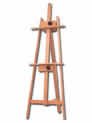
A-Frame Studio
Triangular design fits in corners and smaller studios. Less stable than H-frames but takes much less space. Good mid-range options from Jack Richeson and Mabef.
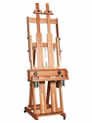
H-Frame Studio
Maximum stability for large canvases and aggressive brushwork. The professional standard—Mabef M09 and Jack Richeson Dulce are industry workhorses. Needs serious floor space.
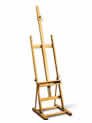
Single Mast
Splits the difference—more stable than A-frames, more compact than H-frames. Good choice when space is tight but you need real studio capability.
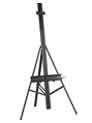
Tripod Field
Lightweight aluminum for outdoor painting. Sets up in seconds, adjusts for uneven terrain. Essential for plein air work.
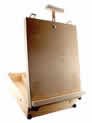
French Box
Complete portable studio—easel, storage, and palette in one package. Heavier than tripods but everything travels together.
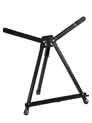
Tabletop
For small-scale work and limited spaces. Don't dismiss these—they're the right tool when floor easels are impossible.
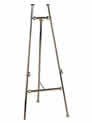
Display
For showing finished work, not painting. Elegant designs that showcase art without competing with it. Essential for galleries and shows.
Shop Easels Supplies
Professional easels supplies for every application
Clamp-On Table Easel
by Jack Richeson

$93.83
BRAZOS Solid Bamboo Studio Easel
by Green Panda

$316.81
Baldwin Metal Folding Floor Easel
by Tripar International

$90.01
Backpacker Aluminum Field Easel
by Pacific Arc

$25.60
ANGELINA Solid Bamboo Easel
by Green Panda

$167.28
Angelina Aluminum Table Top Folding Easel
by Martin/F. Weber

$41.86
500 Classic Easel
by Stanrite

$104.97
180 Aluminum Easel
by Stanrite

$51.07


